
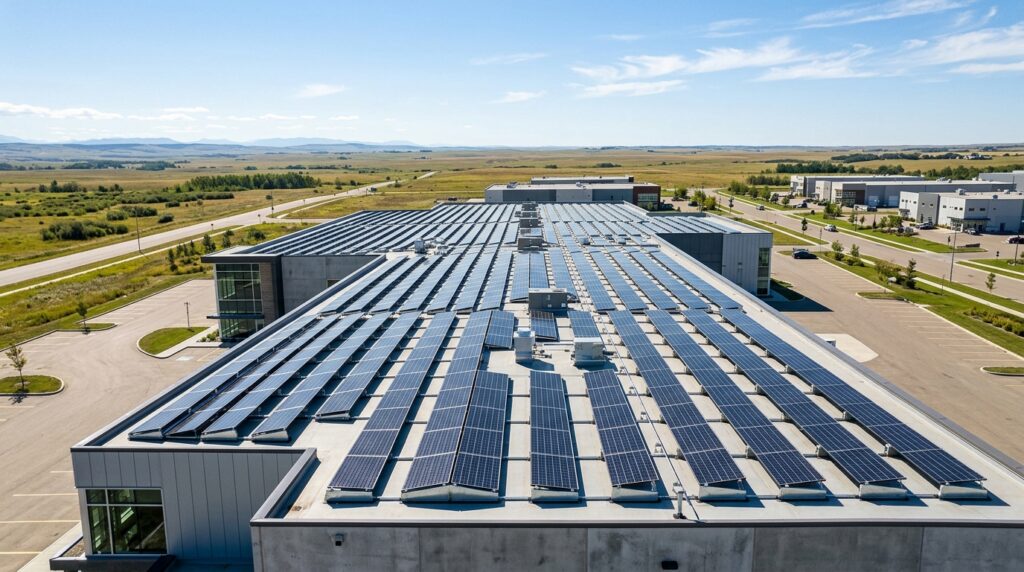
Overview
For businesses exploring commercial solar in Alberta, the decision often comes down to long-term savings and environmental impact. Investing in solar power can substantially reduce operational costs and offer energy independence. This guide examines factors like local incentives, installation processes, and financial returns to help business owners make informed choices about adopting solar energy.
Alberta's robust solar resources and supportive policies create a favorable environment for commercial solar adoption. This page provides a clear breakdown of what businesses need to know, from initial costs to ongoing benefits and future trends.
- Solar in Alberta: Get an overview of commercial solar in the province.
- Benefits & Cost: Learn about the advantages and expenses involved.
- System Costs: Review typical costs for solar systems.
- Incentives & Setup: Find out about incentives and installation steps.
- Incentives & Rebates: Explore specific rebates for commercial solar.
- Panel Installation: Learn about the process of panel installation.
- Net Metering & Future: See how net metering works and future outlook.
- Net Metering Details: Understand microgeneration for businesses.
- Key Trends: Discover important trends in commercial solar.
- Good Fit: Determine if solar is a good fit for your business.
Commercial Solar in Alberta: An Overview
Commercial solar in Alberta offers businesses a path to energy independence and lower operational costs. Alberta's abundant sunshine creates favorable conditions for solar power generation, attracting many businesses to invest in these systems. This renewable energy source helps companies reduce their carbon footprint while managing electricity expenses.
The province's commitment to clean energy makes commercial solar an appealing option for many industries. Businesses can generate their own power, often selling excess electricity back to the grid through programs like net metering. This arrangement can lead to significant long-term savings and increased energy stability. Learn more about business solar.
Alberta's climate, with its clear skies, supports strong solar panel performance. Even in colder temperatures, solar panels operate efficiently, often exceeding expectations due to the cold-weather efficiency of photovoltaic cells. This makes investing in commercial solar a practical choice for facilities across the province.
Benefits and Cost of Commercial Solar in Alberta
Businesses considering commercial solar in Alberta weigh various advantages against initial investment costs. The decision to adopt solar energy for a commercial property involves assessing how it impacts operational expenses and long-term financial stability. A clear look at both benefits and associated costs helps companies make informed choices about their energy future.
Advantages of Adopting Commercial Solar
Installing commercial solar panels offers businesses a pathway to reduce operating costs and gain greater control over energy expenditures. Long summer daylight hours contribute to high energy production, particularly from May to July, when systems can generate 35-40% of their annual output. This surplus can be sold back to the grid, further boosting economic returns for commercial solar Alberta projects.
| Pros of Commercial Solar | Considerations for Implementation |
|---|---|
| Reduced electricity bills | Initial installation expense |
| Predictable energy costs | System maintenance requirements |
| Increased property value | Roof suitability and structural capacity |
| Environmental benefits | Local permitting and grid connection rules |
| Access to incentives | Provincial incentive programs |
Solar panels also perform efficiently in Alberta's cold temperatures; for every degree Celsius below 25°C, most modern panels gain about 0.3-0.5% in electrical efficiency. This performance helps offset concerns about winter conditions. Furthermore, modern Tier-1 solar panels withstand 25mm hail at high speeds, addressing worries about severe weather in "Hailstorm Alley."
Cost of Commercial Solar Systems in Alberta
The initial investment for commercial solar Alberta systems varies widely depending on several factors, including system size, panel efficiency, and installation complexity. Businesses should consider the size of their facility, current energy consumption, and future power needs when estimating costs. Our team has observed that most commercial solar projects in the province typically see a return on investment within 5 to 10 years, a period that can shorten with available incentives.
Projected costs often include equipment (panels, inverters, racking), installation labour, and permitting fees. While some businesses might see higher upfront expenses, the long-term savings on electricity bills and potential for energy independence often outweigh these initial costs. Evaluating the overall financial picture, including operational savings and potential increases in property value, provides a clearer understanding of the economic advantages.
| Cost Factor | Description |
|---|---|
| System Size and Components | Larger systems naturally incur higher costs, but also produce more energy. High-efficiency panels and advanced inverter technology can also influence the total price. Learn about solar components. |
| Installation Complexity | Factors like roof type, tilt, and accessibility affect labor hours and specialized equipment requirements, impacting overall installation expenses. |
| Permitting and Inspections | Local and provincial regulations require permits and inspections, adding to the project's administrative costs. These steps ensure safety and compliance with building codes. |
| Ongoing Maintenance | While solar systems require minimal maintenance, businesses should budget for occasional cleaning and inspections to ensure optimal performance. |
Incentives and Installation for Commercial Solar in Alberta
Businesses considering commercial solar Alberta have several programs to help offset initial costs. These financial incentives, coupled with effective installation practices, make solar a practical investment for many companies. Understanding how these incentives work and what installation involves helps businesses plan their solar projects effectively.
Key Aspects of Commercial Solar Installation
Installing commercial solar panels requires careful planning and execution to ensure optimal performance and adherence to local regulations. Our team can guide you through each stage, from initial assessment to final commissioning. Spring (March through May) is often considered a good time for commercial solar installations, as milder weather supports smoother work and allows systems to be fully operational for peak summer production. Solar planning involves site evaluation.
- Site Assessment: This first step evaluates roof suitability, sun exposure, shading, and structural capacity.
- System Design: Engineers design a system tailored to the business's energy needs and the site's specific characteristics.
- Permitting: Obtaining necessary permits from local authorities ensures compliance with building codes and electrical standards.
- Procurement: High-quality solar panels, inverters, and racking systems are sourced for durability and efficiency.
- Installation: Certified professionals mount the panels and connect the electrical components to the building's grid.
- Inspection and Commissioning: Local electrical inspectors verify the installation meets safety standards before the system is activated.
Commercial Solar Incentives and Rebates in Alberta
Alberta provides several programs designed to support businesses investing in commercial solar. These incentives help reduce the initial expense of installing solar energy systems, making commercial solar alberta projects more attainable. Businesses should research current offerings, as programs can change or have limited funding periods.
Edmonton is a participating municipality in the Alberta Clean Energy Improvement Program, which enables commercial solar projects to be financed with zero upfront cost and repaid through property tax assessments. For specific program details, businesses can contact their local municipality or consult resources like provincial solar program guides.
- The federal government offers the Canada Greener Homes Grant, which includes provisions for commercial entities to reduce energy costs through solar installations.
- Some provincial initiatives or utility programs may provide additional rebates based on system size or energy generation.
- Local municipal programs sometimes offer grants or low-interest loans for sustainable business upgrades.
| Program/Incentive Name | Description | Eligibility Criteria |
|---|---|---|
| Canada Greener Homes Grant | Federal program offering grants for energy-efficient home and building upgrades, including solar PV systems. | Varies by project type and building classification; businesses must meet specific energy audit requirements. |
| Clean Energy Improvement Program (CEIP) | Municipal program providing financing for energy efficiency and renewable energy upgrades, repaid through property taxes. | Available in participating municipalities like Edmonton; property owners must apply through their local CEIP administrator. |
| Emissions Reduction Alberta (ERA) | Offers various funding calls for projects that demonstrate significant greenhouse gas reductions, often including large-scale solar. | Targets projects with significant environmental benefits and innovation; application processes are competitive. |
Commercial Solar Panel Installation in Alberta
Installing commercial solar panels in Alberta requires careful planning and execution to maximize energy production and system longevity. The process typically begins with a thorough site assessment, considering factors like roof integrity, shading, and optimal panel orientation. Proper orientation is key for commercial solar Alberta projects, as it directly impacts how much sunlight the panels capture throughout the day and year.
Edmonton’s Solar Photovoltaic Program recommends orienting commercial arrays between 135° and 225° azimuth—aligning with the city’s strict N-S/E-W grid—to maximize south exposure on flat and low-slope roofs.
- Site Assessment and Design: Engineers evaluate the property, design the system layout, and confirm the building's structural capacity. This initial phase defines the scope and specifics of the solar project, ensuring it aligns with the business's energy needs.
- Permitting and Approvals: Obtaining necessary permits from local authorities and utility companies is a required step. This ensures compliance with all building codes and grid connection standards. Permit applications vary by municipality.
- Procurement: High-quality solar panels, inverters, racking, and electrical components are sourced. Selecting durable equipment that performs well in Alberta's climate is important for system efficiency.
- Installation: Trained professionals mount the racking system, install the solar panels, and complete all electrical wiring. This includes connecting the system to the building's electrical infrastructure and the grid.
- Inspection and Commissioning: Local electrical inspectors and utility representatives inspect the system for safety and compliance. Once approved, the system is activated, and monitoring equipment is configured.
| Phase | Description |
|---|---|
| Pre-Installation | Includes site surveys, energy audits, system design, and securing all necessary permits and approvals from local and provincial bodies. |
| Physical Installation | This stage involves mounting racking, placing panels, electrical wiring, and inverter installation. Safety protocols are followed closely. |
| Post-Installation | Final inspections, system commissioning, and connecting to the grid. Our team also provides monitoring and maintenance support. |
Net Metering and Future of Commercial Solar in Alberta
Net metering allows businesses with solar installations to send excess electricity back to the grid for credits. This system provides financial benefits, as it offsets the cost of electricity consumed from the grid when solar production is low. Alberta's net metering policy supports the growth of commercial solar Alberta, making it a sound investment for many businesses.
The Role of Net Metering in Solar Profitability
Net metering is a billing mechanism that credits solar energy system owners for the electricity they add to the grid. When your solar panels produce more electricity than your business consumes, that surplus power goes back into the utility grid. You receive a credit on your electricity bill for this excess generation, which can then be used to offset future electricity consumption. This process helps maximize the financial returns from a commercial solar installation. Learn more about incentives.
| Pros | Cons |
|---|---|
| Reduces overall electricity bills | Credit rates may vary by utility |
| Supports grid stability during peak production | Potential for future policy changes |
| Maximizes the value of solar generation | Requires careful system sizing |
Net Metering and Microgeneration for Alberta Businesses
Net metering allows businesses with commercial solar Alberta installations to send excess electricity back to the grid. This process credits their account, which helps offset future electricity bills when their solar system produces less power than consumed. This system creates a financial incentive for businesses to install solar panels, maximizing their self-sufficiency and reducing reliance on traditional energy sources.
Microgeneration involves smaller-scale renewable energy systems, typically under 5 megawatts, designed to serve individual homes or businesses. These systems, like rooftop solar arrays, can generate power for onsite use and contribute surplus electricity to the grid through net metering. Alberta's microgeneration regulations support this, allowing businesses to receive fair compensation for the power they add to the provincial grid. Microgeneration regulations
| Pros | Cons |
|---|---|
| Reduces monthly electricity costs | Requires initial investment |
| Earns credits for excess power generation | Output varies with weather and seasons |
| Supports energy independence | Grid connection standards must be met |
| Contributes to a cleaner energy supply | Changes in policy affect future benefits |
Key Trends for Commercial Solar in Alberta
The market for commercial solar in Alberta continues to evolve with notable growth and technological progress. Businesses increasingly consider solar energy for long-term operational savings and environmental benefits. This reflects a broader shift towards sustainable practices across various industries.
Technological advancements play a significant role, with improvements in panel efficiency and energy storage solutions making systems more attractive. For instance, large Alberta warehouses often incorporate adjustable racking, allowing twice-annual tilt adjustments at the March and September equinoxes to optimize for summer versus winter sun paths solar panel efficiency. These innovations enhance output, making commercial solar installations a practical investment for many Alberta businesses.
Is Commercial Solar a Good Fit for Your Alberta Business?
Considering commercial solar for your business requires evaluating your operational needs and energy goals. Businesses with significant daytime energy consumption, like offices, retail stores, or manufacturing facilities, often see the most direct benefits from commercial solar Alberta installations. The ability to generate your own power during peak hours can substantially lower electricity costs and provide energy price stability.
Installing solar panels also positions your business as environmentally aware, which can appeal to customers and partners. Our team helps assess your facility's energy profile and roof suitability to determine the best approach for a solar power system. We can also provide information on available incentives that further reduce upfront costs.
FAQ
To help you better understand the nuances of commercial solar in Alberta, we’ve compiled answers to some of the most common questions businesses have about making the switch to solar energy.
| Question | Answer |
|---|---|
| What are the main benefits of installing commercial solar in Alberta? | Commercial solar in Alberta offers businesses reduced electricity bills and greater energy independence. Long summer daylight hours contribute to high energy production, with systems generating 35-40% of their annual output during peak months. Panels also perform efficiently in cold temperatures, gaining electrical efficiency as temperatures drop below 25°C. |
| How much does a commercial solar system typically cost in Alberta? | The initial investment for commercial solar systems in Alberta varies based on system size, panel efficiency, and installation complexity. Most projects see a return on investment within 5 to 10 years, a period that can be shortened by available incentives. Costs include equipment, labor, and permitting fees. |
| What incentives are available for commercial solar projects in Alberta? | Alberta offers programs like the Clean Energy Improvement Program (CEIP) in municipalities such as Edmonton, allowing financing through property taxes with zero upfront cost. The federal Canada Greener Homes Grant also provides provisions for commercial entities. Businesses should research current municipal and provincial offerings. |
| When is the best time to install commercial solar panels in Alberta? | Spring, typically from March through May, is often considered a good time for commercial solar installations in Alberta. Milder weather during these months supports smoother work and allows systems to be fully operational for peak summer production. |


