
Answer
Multi Unit Residential Solar installations offer property owners substantial long-term savings on electricity costs and enhance property value. The Alberta government provides rebates through the Residential and Commercial Solar Program, which reduces initial investment for multi-unit properties. Ridgeline Solar helps property owners assess their buildings for optimal solar placement, ensuring maximum energy production and financial benefit.
Overview
Multi Unit Residential Solar installations offer property owners in Alberta significant opportunities to reduce operating costs and boost property value. Our team at Ridgeline Solar helps building managers explore solar power solutions tailored to their specific properties. This article outlines key aspects of adopting solar energy for multi-unit buildings, including a hypothetical comparison of different solar approaches.
We explore how solar can impact property finances, common installation factors, available incentives, and steps to get started. A real-world hypothetical scenario compares two common solar investment paths for multi-unit properties.
- Maximizing Returns: Discover strategies to maximize financial returns with solar in Edmonton.
- Real-World Example: See a hypothetical comparison of solar investments.
- Installation Factors: Review key considerations for Alberta installations.
- Alberta Incentives: Learn about financing and incentives in Alberta.
- Investment Timelines: Examine ROI and payback periods.
- Optimal Timing: Identify when solar makes sense for your property.
- Getting Started: Plan your next steps with Ridgeline Solar.
Maximizing ROI and Savings with Multi-Unit Residential Solar in Edmonton
Ridgeline Solar works with property owners in Edmonton to enhance the return on investment for multi-unit residential solar installations. We help design systems that significantly lower electricity costs, directly improving property profitability. Our team has experience tailoring solutions for various multi-unit structures, optimizing for maximum energy generation and financial benefits.
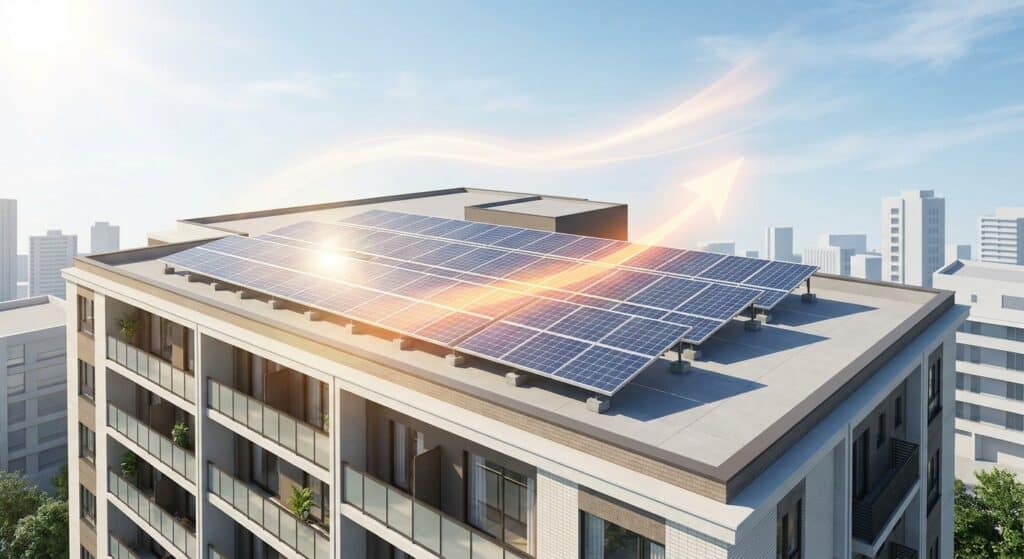
Many multi-unit residential buildings in Alberta utilize solar technology to reduce energy costs. These properties often feature flat roofs, which are well-suited for solar panel installations, allowing for optimal sun exposure. We ensure compliance with Alberta Building Code requirements for every project, providing peace of mind for property owners.
Hypothetical scenario:
Consider two identical multi-unit residential buildings in Edmonton, each with an average annual electricity bill of $15,000 CAD. Building A invests in a 50 kW multi-unit residential solar system, costing approximately $80,000 CAD after incentives. This system offsets about 70% of its annual electricity consumption, reducing the bill to $4,500 CAD per year. Building B, however, defers solar installation, continuing to pay the full $15,000 CAD annually. Over ten years, Building A saves $105,000 CAD in electricity costs, plus potential earnings from selling excess power back to the grid through net metering, while Building B accumulates $150,000 CAD in electricity expenses. The solar investment pays for itself within approximately 7-8 years, depending on energy usage and available incentives like those described for Alberta solar rebates.
Key Considerations for Multi-Unit Solar Installations in Alberta
Property owners in Alberta planning multi-unit residential solar installations face unique environmental and structural factors. Our team at Ridgeline Solar helps address these specific challenges, ensuring successful project outcomes. These considerations affect system design, energy production, and maintenance requirements.
Alberta’s climate, with its long summer days and significant winter snow, directly impacts solar system performance. While the region benefits from approximately 2,300 hours of sunshine annually, snow accumulation on panels during colder months can temporarily reduce energy generation. However, cold temperatures themselves can enhance solar panel efficiency once cleared of snow.
The table below outlines key factors for multi-unit solar projects in Alberta:
| Consideration | Impact on Multi-Unit Solar Projects |
|---|---|
| Roof Type and Condition | Flat roofs on many multi-unit residential buildings in Alberta suit optimal solar panel placement. Roof structural integrity must support the additional weight. |
| Shading Obstructions | Nearby buildings or large trees can reduce solar energy production; a thorough site assessment identifies and mitigates potential shading. Proper system design accounts for these elements. |
| Snow Management | Winter snow accumulation requires planning for removal or panel tilt adjustments to maintain optimal output. Cold temperatures can improve panel performance when panels are clear. |
| Alberta Building Code | All installations must comply with provincial building codes for structural safety and integrity. Permitting and regulations ensure adherence to local standards. |
| Homeowners’ Associations | Condo complexes often have HOAs with specific rules on exterior modifications, which may affect solar panel installations. Property managers secure necessary approvals. |
Alberta’s Incentives and Financing for Multi-Unit Solar Projects
Property owners considering multi-unit residential solar in Alberta benefit from various incentives and financing solutions. These programs help reduce upfront costs and improve the financial viability of solar projects. Ridgeline Solar helps clients find the most suitable options for their specific multi-unit properties.
The provincial government actively promotes renewable energy adoption. Property owners can access rebates and financing through programs designed to support solar photovoltaic systems. We guide clients through the application processes to maximize their benefits.
-
Government Rebates: The Alberta government offers the Residential and Commercial Solar Program. This program provides rebates for solar panel installations, which makes investments in solar more attractive for multi-unit buildings. Local incentives and rebates can vary by municipality, prompting property managers to investigate specific opportunities.
-
Net Metering Programs: Alberta’s net metering policies enable multi-unit buildings to sell excess solar energy back to the grid. This policy provides a potential revenue stream and improves the financial aspects of solar investments.
-
Community Solar Initiatives: Community solar programs are growing in Alberta. These initiatives allow multi-unit buildings to participate in shared solar projects, which can offer additional savings without requiring individual installations.
| Incentive Type | Description |
|---|---|
| Provincial Rebates | The Residential and Commercial Solar Program provides financial incentives for installing solar panels on multi-unit properties. Program details |
| Net Metering | Property owners receive credit for surplus electricity fed back into the provincial grid. This program contributes to long-term savings. |
| Financing Options | Several financial institutions offer loans and specialized financing products tailored for solar installations. Owners can explore various terms and rates. |
| Property Value Increase | Solar installations can enhance property value and attract eco-conscious residents, especially those seeking LEED certification. Property value impact |
ROI and Payback Periods for Multi-Unit Solar
Calculating the return on investment (ROI) and payback period for multi-unit residential solar projects involves several factors. Alberta’s generous annual sunshine, averaging about 2,300 hours, helps accelerate these returns for property owners. Energy cost savings often range from 20% to 50% depending on system size and the building’s energy consumption patterns, directly impacting how quickly an investment pays for itself.
Incentives from the Alberta government can significantly reduce initial installation costs, further shortening payback times. Property owners seeking to implement Multi Unit Residential Solar should consider current electricity rates and available rebates. Our team often sees payback periods fall within 8-12 years for well-planned installations, but specific project details and energy usage determine the exact timeline.
Sometimes, unexpected roof conditions or complex electrical system upgrades can extend the initial investment. Ridgeline Solar helps property managers evaluate these factors to provide realistic projections. We analyze each building’s unique characteristics to develop a customized proposal, ensuring you have clear expectations for your investment. Contact us to discuss how solar can benefit your property.
| Factor | Impact on ROI/Payback |
|---|---|
| High Annual Sunshine | Alberta averages 2,300 hours of sunshine annually, boosting energy production and faster returns. |
| Energy Cost Savings | Potential savings of 20-50% on electricity bills shorten payback periods. |
| Government Incentives | Rebates and programs lower upfront costs, improving financial viability. |
| System Size & Consumption | Larger systems and higher energy use lead to greater savings and quicker ROI. |
| Roof Condition | Major roof repairs needed before installation can extend the overall payback timeline. |
When Multi-Unit Solar Makes the Most Sense
Property owners consider multi-unit residential solar solutions when specific conditions align. Our team finds that buildings with significant unshaded roof space offer the best potential for energy generation. Projects often proceed when owners seek long-term operational savings and improved property value.Flat roofs, common on many multi-unit residential buildings in Alberta, are ideal for solar panel installations because they allow for optimal sun exposure. Alberta’s average annual sunshine of about 2,300 hours also contributes to faster returns on investment for these properties. Multi-unit residential solar becomes a clear choice for properties aiming to offset high energy consumption, especially in urban areas.
Consider the following scenarios when evaluating a solar installation:
| Scenario | When Multi-Unit Solar May Work Best |
|---|---|
| High Energy Costs | Buildings with substantial electricity bills can achieve significant savings, particularly during peak usage periods like winter heating months. |
| Available Roof Space | Properties featuring large, unobstructed flat roofs maximize solar panel placement and energy production. |
| Long-Term Ownership | Owners planning to retain the property for an extended period can fully realize the financial benefits and payback from the investment. |
| Sustainability Goals | Developments targeting LEED certification or attracting eco-conscious residents find solar aligns with their objectives. |
| Access to Incentives | Projects eligible for provincial rebates or net metering programs gain a financial advantage. |
Your Next Steps with Ridgeline Solar
Moving forward with a solar energy system for your multi-unit residential property involves several considerations. Ridgeline Solar simplifies this process by offering tailored consultations and expert installation services.
We work with property owners in Edmonton and the surrounding area to design systems that align with specific energy goals and building requirements. Our team assesses your property’s solar potential and outlines applicable incentives, ensuring a clear path to energy independence.
| Action Item | Description |
|---|---|
| Schedule a Consultation | Connect with our experts to discuss your property’s needs and receive a personalized assessment for multi-unit residential solar solutions. Contact us to begin. |
| Explore Financing Options | We assist you in reviewing available financing programs and incentives for solar installations in Alberta, helping you choose the best fit. Learn about financing for your project. |
| Receive a Custom Proposal | Our team provides a detailed proposal outlining system design, projected savings, and return on investment. This helps you visualize the benefits for your specific building. |
FAQ
Below, we address some common questions regarding Multi Unit Residential Solar installations, focusing on their financial benefits and practical considerations.
| Question | Answer |
|---|---|
| What incentives are available for multi-unit residential solar projects in Alberta? | Alberta offers the Residential and Commercial Solar Program, which provides rebates for installing solar panels on multi-unit properties. Local municipalities may also offer additional incentives. Net metering programs allow you to sell excess solar energy back to the grid, creating a potential revenue stream. |
| How long does it typically take to see a return on investment for multi-unit solar in Alberta? | The payback period for multi-unit residential solar projects in Alberta generally falls between 8-12 years. This timeline can be influenced by factors such as system size, the building’s energy consumption, available government incentives, and Alberta’s abundant annual sunshine. |
| Can solar panels be installed on condo buildings in Alberta, and what should be considered? | Yes, solar panels can be installed on condo buildings in Alberta, especially those with flat roofs suitable for optimal sun exposure. Key considerations include complying with the Alberta Building Code, potential restrictions from homeowners’ associations, and planning for winter snow management to maintain panel efficiency. |
| When is the best time to consider a multi-unit solar installation in Edmonton? | Installing solar on a multi-unit residential property makes sense when you have significant unshaded roof space and are looking for long-term operational savings and increased property value. Properties with high electricity bills, especially those aiming for sustainability goals or LEED certification, can benefit greatly from solar. |


