
Answer
Commercial solar installation projects in Alberta can be engineered for harsh winters, snow load, and freeze conditions, with systems commonly described as being designed to withstand these elements. Alberta’s cold weather increases solar panel efficiency, providing a performance bonus for commercial systems, while significant snowfall may cause about a 3% annual energy loss, a figure lower than previously estimated according to a NAIT study. Ridgeline Solar, established in 2016, has constructed and managed over 8 MW of projects across Alberta, demonstrating extensive experience in large-scale solar development and offering custom-designed installations to reduce operating costs.
Overview
This section maps out how commercial solar installation projects in Alberta are shaped by local conditions and business needs. It covers the specific challenges presented by Edmonton’s urban environment and the broader impacts of Alberta’s climate on solar energy generation. Readers will also find details on selecting appropriate solar systems for businesses, a real-world example illustrating a business owner’s journey, our company’s approach to installations, specific recommendations for Alberta businesses, and guidance on getting started with commercial solar projects.
The complexities of adopting solar power for businesses are explored through a hypothetical scenario. Eleanor Vance, owner of a medium-sized manufacturing business in Alberta, faces the decision of whether to invest in a commercial solar installation now or await future technological advancements. This scenario highlights the typical considerations businesses face regarding upfront costs and long-term suitability in Alberta’s climate.
- Edmonton Challenges: Review the specific hurdles for solar installations within Edmonton’s urban landscape.
- Climate Impact: Examine how Alberta‘s weather affects the performance and planning of solar energy systems.
- System Selection: Gain insight into choosing the right solar components for commercial applications.
- Real-World Example: Eleanor Vance navigates the decision process for her business.
- Our Approach: Discover the methods Ridgeline Solar uses for commercial solar projects.
- Alberta Recommendations: Find tailored advice for solar investments suited to businesses in Alberta.
- Getting Started: Learn the initial steps for initiating a commercial solar project.
## Edmonton Solar Installation Challenges Commercial solar installations in Edmonton face unique considerations due to the city’s specific climate, building stock, and regulatory environment. Edmonton’s Commercial Cultural Core zoning bylaw, for instance, explicitly permits “solar collectors” as an allowable roof design element, which streamlines permitting for building-integrated solar systems along key commercial streets. This regulation aids in the integration of solar on facades, moving beyond traditional rooftop arrays. Navigating the permitting process for commercial solar in Edmonton requires attention to local building codes and potential utility interconnection requirements. The city’s climate also presents challenges, with significant snowfall potentially impacting system performance during winter months. While Alberta’s cold weather can increase panel efficiency, seasonal snow loading on flat roofs, which are common for many commercial buildings in Edmonton, peaks in December. Installers must therefore specify appropriate pitched array mounts or snow guards to ensure effective snow shedding and maintain energy production. Furthermore, cold-climate wind loads are a significant design factor, necessitating wind-rated mounting systems to withstand regional gusts. Commercial solar panels in Edmonton must be engineered to meet these stringent local demands, ensuring both safety and optimal performance.
As proud members of the Solar Energy Society of Alberta (SESA), our team includes Master Electricians and Alternative Energy Technologists, ensuring each commercial installation meets the highest technical and safety standards.
To make commercial solar installation projects both affordable and effective, we work closely with clients to offer creative and flexible financing options tailored to each business’s budget and objectives.
| Edmonton Solar Challenge | Impact on Installation |
|---|---|
| Zoning Bylaw allowances for solar collectors | Streamlines permitting for building-integrated solar on facades and rooftops. |
| Seasonal snow loading on flat roofs | Requires pitched array mounts or snow guards to ensure effective snow shedding and continued energy production. |
| Cold-climate wind loads | Demands wind-rated mounting systems capable of withstanding regional gusts, enhancing structural integrity. |
| Permitting and Utility Interconnection | Requires adherence to local building codes and coordination with utility providers for system integration. |
Alberta Climate Impact on Solar Projects
Alberta’s climate significantly shapes the design and performance of commercial solar installations. While the province offers strong annual sunlight for power generation, its distinct seasons, including heavy snowfall and extreme temperatures, require careful consideration in system planning and installation. Understanding these climatic factors is essential for businesses to achieve optimal energy production and long-term system reliability.
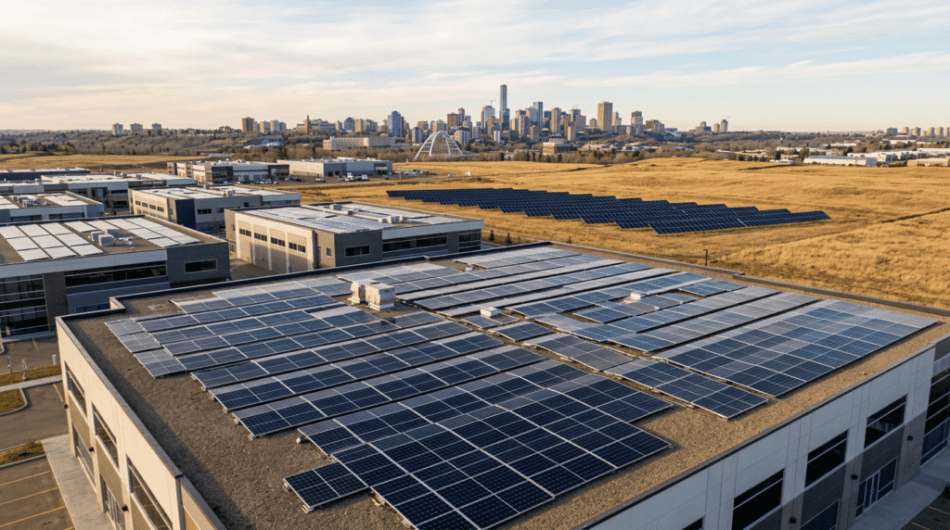
Commercial buildings in Alberta, particularly those in Calgary and Edmonton, often feature large, unobstructed flat or low-slope roofs, which are ideal for maximizing sun exposure and commercial solar panel placement. Alberta’s climate also presents a unique advantage: the cold weather can actually increase solar panel efficiency, providing a performance bonus for commercial systems that operate at lower temperatures. This is a key factor for businesses looking to maximize their energy generation throughout the year.
| Climate Factor | Impact on Commercial Solar Installation |
|---|---|
| Sunlight Hours | Alberta receives strong annual sunlight, with Calgary averaging 2,405 hours and Edmonton 2,345 hours per year. This high level of solar irradiance makes the province a prime location for commercial solar installations, supporting robust energy production. |
| Snowfall | Significant snowfall can affect commercial solar panel production. However, a 5-year study by NAIT found that snow causes only about a 3% annual energy loss, much lower than previous estimates. Systems are engineered for harsh winters and snow load, with pitched array mounts or snow guards often specified to help panels shed snow more effectively. |
| Temperature | Cold weather increases solar panel efficiency. Panels perform better at lower temperatures, offering a \”cold-weather bonus\” for commercial solar systems in Alberta. Optimal tilt angles for maximum annual production are often around 45°, while steeper angles can aid in winter snow shedding. |
| Wind Loads | Commercial installations, especially along Edmonton’s Anthony Henday ring road, require wind-rated mounting systems designed to withstand gusts up to 100 km/h recorded in the region. This ensures system integrity and safety during severe weather events. |
Ridgeline Solar tailors commercial solar installations to account for Alberta’s specific climate conditions. Our custom-designed systems are engineered to maximize energy generation despite seasonal variations, helping businesses reduce operating costs and enhance their green footprint. We ensure each installation meets the highest technical and safety standards, providing reliable, sustainable energy solutions.
Choosing Solar Systems for Businesses
Selecting the right commercial solar system involves evaluating your business’s energy consumption, available roof or ground space, and financial objectives. Businesses in Alberta often consider system size based on their current electricity bills and future energy needs. The goal is typically to offset a significant portion of energy costs while ensuring the system’s longevity and reliability in the local climate.
As proud members of the Solar Energy Society of Alberta (SESA), our team includes Master Electricians and Alternative Energy Technologists, ensuring each commercial installation meets the highest technical and safety standards. Our commercial installations are custom-designed to reduce operating costs and enhance a business’s green footprint, delivering sustainable energy solutions that align with corporate sustainability goals. We have constructed and managed over 8 MW of projects for commercial, residential, and utility customers across Alberta, giving us extensive experience in large-scale solar development.
| System Type | Best for | Budget | Reason |
|---|---|---|---|
| Rooftop Solar Arrays | Businesses with ample, unobstructed roof space, such as warehouses or large retail buildings. | Quote; varies with roof size, material, and system complexity. | Leverages existing infrastructure, minimizing land use and often requiring less complex permitting than ground mounts. Flat or low-slope roofs common in commercial buildings are suitable for ballasted systems that do not penetrate the roof membrane, as noted in Alberta Infrastructure’s Solar PV Guidelines. |
| Ground-Mounted Systems | Businesses with available land adjacent to their facility, like agricultural co-ops or industrial sites with large outdoor areas. | Quote; varies with land size, trenching requirements, and mounting hardware. | Allows for optimal tilt angles for year-round production and easier snow shedding, a key consideration in Alberta’s climate. Systems can be engineered for harsh winters, snow load, and freeze conditions, providing a practical solution for energy generation. |
| Solar Carports and Canopies | Businesses needing parking solutions and solar generation simultaneously, such as office parks or retail centres with large parking lots. | Quote; typically higher initial cost due to structural requirements. | Provides dual benefits: shade for vehicles and power generation. East-facing canopies, for example, can maximize morning solar incidence, complementing rooftop arrays and improving overall system output. |
When selecting a system, consider the roof type and pitch. Standing-seam metal roofs are generally simpler and cheaper to work on than some flat roofs, which may require more complex mounting solutions. To make commercial solar installation projects both affordable and effective, we work closely with clients to offer creative and flexible financing options tailored to each business’s budget and objectives. We provide installations across Northern Alberta, ensuring businesses throughout the region can access these turnkey solutions.
A Business Owner’s Solar Journey
Businesses considering solar power in Alberta face a critical decision regarding system design to optimize performance and withstand the unique climate challenges, including snow load and frigid temperatures. Balancing initial investment with long-term operational benefits requires careful consideration of installer expertise and system resilience.
Eleanor Vance is evaluating commercial solar installation options for her property in Alberta, a region known for its harsh winters and significant snowfall. She’s concerned about potential energy loss from snow cover and the structural integrity of panels under heavy snow loads. Given Alberta’s climate, should Eleanor prioritize a system engineered for maximum snow load or one focused on maximizing sunlight capture year-round for her commercial solar installation?
Recommendation: Custom-designed solar installation engineered for Alberta’s climate
Ridgeline Solar recommends a custom-designed solar installation engineered to withstand Alberta’s harsh winters and snow loads, while also optimizing for sunlight capture. This approach balances the need for durability with maximizing energy generation potential throughout the year.
Our Commercial Solar Installation Approach
Our approach to commercial solar installation in Alberta focuses on delivering tailored solutions that maximize energy generation and operational savings for businesses. We begin each project with a thorough site assessment, examining roof structure, available space, and energy consumption patterns to design a system that precisely fits your facility’s needs.
Ridgeline Solar, established in 2016, has constructed and managed over 8 MW of projects across Alberta, demonstrating extensive experience in large-scale solar development. Our team includes Master Electricians and Alternative Energy Technologists, ensuring each commercial installation meets the highest technical and safety standards, adhering to local building codes and regulations.
We work closely with clients to offer creative and flexible financing options, making commercial solar installation projects both affordable and effective. Our custom-designed installations aim to reduce operating costs and enhance a business’s green footprint, delivering sustainable energy solutions that align with corporate sustainability goals. We pride ourselves on providing comprehensive project management from initial assessment through to commissioning, ensuring a smooth transition to solar energy.
| Process Step | Description |
|---|---|
| Site Assessment & Analysis | Detailed evaluation of roof condition, structural integrity, energy usage, and site-specific solar potential. This includes assessing available space for panels and inverter placement, considering factors like shading and potential obstructions. |
| System Design & Engineering | Custom design of the solar array, specifying panel types, mounting systems (e.g., ballasted, anchored, or standing-seam metal roof compatible), inverters, and other components. Engineering ensures the system meets Alberta’s harsh climate demands, including snow load and wind resistance, and complies with all building and electrical codes. |
| Permitting & Approvals | Managing the application process for all necessary permits, including development and electrical permits, and coordinating with local utility companies for interconnection agreements. This phase also involves obtaining structural engineering assessments where required. |
| Installation & Commissioning | Professional installation by our certified electricians and technologists, followed by rigorous system testing and commissioning to ensure optimal performance and safety. This includes proper grounding, surge protection, and integration with existing electrical infrastructure. |
| Monitoring & Maintenance Support | Setting up performance monitoring systems to track energy production and providing ongoing support and maintenance recommendations to ensure the system’s long-term efficiency and reliability. |
Solar Recommendations for Alberta Businesses
Commercial solar installations in Alberta are frequently sized around annual output, accommodating reduced production during shorter winter days and snow cover. This approach ensures systems remain effective throughout the year, a key consideration for businesses. For commercial solar installation in Alberta, roof type and pitch are discussed early in the quoting process, as installers often ask for this information before design work begins. Many buildings in Alberta, particularly warehouses and light-industrial facilities, feature large rooftops that are practical for substantial solar arrays, driven by roof availability and existing electrical infrastructure. Commercial solar panels are a strong option for businesses with significant daytime electricity use, aligning with their operational hours.
When selecting a system, the choice between standing-seam metal roofs and small flat roofs presents different installation considerations. Standing-seam metal roofs often prove simpler and cheaper to work on than flat roofs, which may require more complex mounting systems. Alberta's cold weather, while challenging, can also enhance solar panel efficiency, offering a performance bonus at lower temperatures. Commercial solar projects in Alberta commonly go through ENMAX, EPCOR, or ATCO for interconnection, depending on the service area, making local grid knowledge an important factor. Ridgeline Solar, established in 2016, has constructed and managed over 8 MW of projects across Alberta, demonstrating extensive experience in large-scale solar development.
Businesses looking to reduce operating costs and enhance their green footprint can find significant value in commercial solar. Our commercial installations are custom-designed to deliver sustainable energy solutions that align with corporate sustainability goals. To make these projects both affordable and effective, we work closely with clients to offer creative and flexible financing options tailored to each business’s budget and objectives. For businesses seeking to optimize their energy strategy, exploring options like commercial solar solutions can provide long-term financial and environmental benefits.
| Product | Best for | Budget | Reason |
|---|---|---|---|
| Rooftop Solar Array (Ballasted) | Businesses with large, flat, or low-slope roofs and minimal structural impediments. | Quote; varies with roof size and system capacity. | Ideal for maximizing south-facing exposure and utilizing existing roof space without roof penetrations, common on many commercial buildings in Calgary and Edmonton. |
| Rooftop Solar Array (Pitched Metal Roof Mount) | Facilities with 3/12 pitched metal roofs designed to withstand hail. | Quote; varies with roof size and system capacity. | Specialized mounting rails avoid drilling into metal seams, a practice often seen on mid-1990s warehouse-style buildings and suitable for Alberta's climate. |
| Solar Canopies/Carports | Businesses with ample parking areas adjacent to main structures or requiring shade. | Quote; varies with size and design complexity. | Maximizes solar incidence on east- and south-facing facades, as seen on commercial arteries in Calgary, combining parking utility with energy generation. |
| Building-Integrated Photovoltaics (BIPV) | Businesses seeking advanced architectural integration, such as on iconic facades or with translucent panels. | Higher Quote; involves specialized design and materials. | Showcases potential for photovoltaic integration beyond traditional rooftops, as demonstrated by projects like the priMED Mosaic Centre in Edmonton, producing net-zero energy. |
| Ground-Mounted Arrays | Agricultural operations or facilities with significant land availability adjacent to buildings. | Quote; varies with land size and array configuration. | Practical for sites like agricultural co-ops around Rocky View County, allowing for large-scale energy generation where roof space is limited or unsuitable. |
Ridgeline Solar offers custom-designed commercial solar installations, ensuring businesses can access effective and affordable energy solutions.
## Getting Started with Commercial Solar
Initiating a commercial solar installation project involves several key steps, beginning with a thorough assessment to determine system feasibility and financial viability. This initial evaluation considers factors such as roof condition, energy consumption patterns, and local regulations to create a foundational plan tailored to your business’s unique needs and the Alberta environment. Following the initial assessment, the process moves into system design and permitting. This stage involves detailed engineering to specify the solar components, mounting systems, and electrical configurations, ensuring compliance with all relevant building codes and utility interconnection requirements. Obtaining the necessary permits can be a detailed process, and it is here that understanding provincial guidelines, such as those from Alberta Infrastructure, becomes important for smooth project progression. Alberta Infrastructure provide a framework for these requirements. The final phases involve system installation, interconnection with the grid, and ongoing performance monitoring. Each step is managed to ensure the commercial solar array is installed safely, efficiently, and in alignment with the designed specifications. Our commercial installations are custom-designed to reduce operating costs and enhance a business’s green footprint, delivering sustainable energy solutions that align with corporate sustainability goals. To make commercial solar installation projects both affordable and effective, we work closely with clients to offer creative and flexible financing options tailored to each business’s budget and objectives.
- Site Assessment and Feasibility Study Conduct a comprehensive review of your business’s energy usage, roof space, structural integrity, and local shading factors to determine the optimal system size and type.
- System Design and Engineering Develop detailed plans for the solar array, including panel selection, inverter specifications, mounting hardware, and electrical interconnection, ensuring compliance with all safety and code requirements.
- Permitting and Approvals Secure all necessary municipal and utility permits, which may involve structural engineering assessments to verify roof load capacity for snow and wind conditions common in Alberta.
- Procurement and Installation Purchase high-quality solar components and engage experienced installers to execute the system build according to engineered specifications.
- Interconnection and Commissioning Coordinate with the local utility provider for grid interconnection and conduct final system testing to ensure optimal performance before going live.
- Monitoring and Maintenance Implement a system for ongoing performance monitoring to track energy production and identify any potential issues, ensuring the system operates efficiently over its lifespan.
We have constructed and managed over 8 MW of projects for commercial, residential, and utility customers, demonstrating extensive experience in large-scale solar development across Alberta. As proud members of the Solar Energy Society of Alberta (SESA), our team includes Master Electricians and Alternative Energy Technologists, ensuring each commercial installation meets the highest technical and safety standards. Alberta presents unique challenges, such as significant snow loads, which our engineers factor into every design.
FAQ
Below, we’ve compiled answers to some of the most common questions regarding commercial solar installation Alberta businesses face, particularly concerning the unique climate and operational considerations in the province.
| Question | Answer |
|---|---|
| How does Alberta’s cold weather impact commercial solar panel efficiency? | Alberta’s cold weather can actually increase solar panel efficiency. Panels perform better at lower temperatures, offering a "cold-weather bonus" for commercial solar systems. This is a key advantage for businesses in the province looking to maximize their energy generation throughout the year. |
| What are the typical challenges for commercial solar installations in Edmonton? | Commercial solar installations in Edmonton face challenges including significant snowfall, which can impact performance during winter. Cold-climate wind loads also necessitate wind-rated mounting systems. Edmonton’s zoning bylaws permit solar collectors, streamlining integration, but installers must specify appropriate mounts for effective snow shedding. |
| How does snowfall affect commercial solar panel production in Alberta? | Significant snowfall can affect commercial solar panel production. However, a 5-year study by NAIT found that snow causes only about a 3% annual energy loss, which is lower than previous estimates. Systems are commonly engineered for harsh winters and snow load, with pitched array mounts or snow guards helping panels shed snow more effectively. |
| What is the recommended approach for commercial solar installations in Alberta’s climate? | A custom-designed solar installation engineered to withstand Alberta’s harsh winters and snow loads is recommended. This approach ensures systems are resilient while also optimizing for sunlight capture year-round, balancing initial investment with long-term operational benefits for businesses in the region. |


